If you are choosing between Arlington and Medford, you are not really choosing between a clear "better" town and a clear "worse" one. You are choosing between two close-in Middlesex County communities that offer different daily rhythms, housing patterns, and commuting options. The right fit depends on how you want to live, move around, and compete in the market. Let’s dive in.
Arlington vs. Medford at a glance
Arlington and Medford sit in a similar price conversation, but they do not feel identical once you look past headline numbers. Recent Redfin snapshots show Arlington at a median sale price of $857,000 and Medford at $861,000, so the top-line pricing is very close.
Where the difference shows up is market pace. Redfin market data for Arlington indicates homes are moving in about 18 days with 5 offers on average, while Medford is taking about 38 days with 3 offers on average. That suggests Arlington is currently the tighter, faster-moving market.
Compare your daily commute
For many buyers, the biggest difference between Arlington and Medford is not price. It is how you get where you need to go on a normal weekday.
Arlington transit options
Arlington relies heavily on buses, biking, and nearby access to Alewife. According to Arlington transportation information, the town is served by 12 MBTA bus routes, with major connections to Alewife Station and other destinations along Massachusetts Avenue.
Arlington also has a strong biking identity. The town highlights the Minuteman Bikeway as a major commuting and recreation corridor, which is a real advantage if you want car-light mobility and easy trail access.
Medford transit options
Medford offers a broader range of transit modes. The city’s resident guide notes that Medford has Green Line access at Medford/Tufts and Ball Square, Orange Line service at Wellington, commuter rail service at West Medford on the Lowell Line, and multiple MBTA bus routes.
That mix matters if you want flexibility. Medford also continues to build out bike connections and has added new BlueBike stations, including links connected to the Medford/Tufts area.
Commute data in context
The commute times are fairly close. Data USA profiles show Arlington averaging a 32.2-minute mean commute and Medford averaging 30.2 minutes.
The more useful difference is the mode split. Arlington has a larger work-from-home share at 34.5%, while Medford has a higher drive-alone share at 48.4% and a slightly higher public transit share at 11.9%. In practical terms, Medford gives you more rail choices, while Arlington leans more on buses, biking, and nearby subway access.
Housing stock feels different
Even when two towns have similar sale prices, the homes you tour may look and feel very different. That is one of the most important parts of this decision.
Arlington housing character
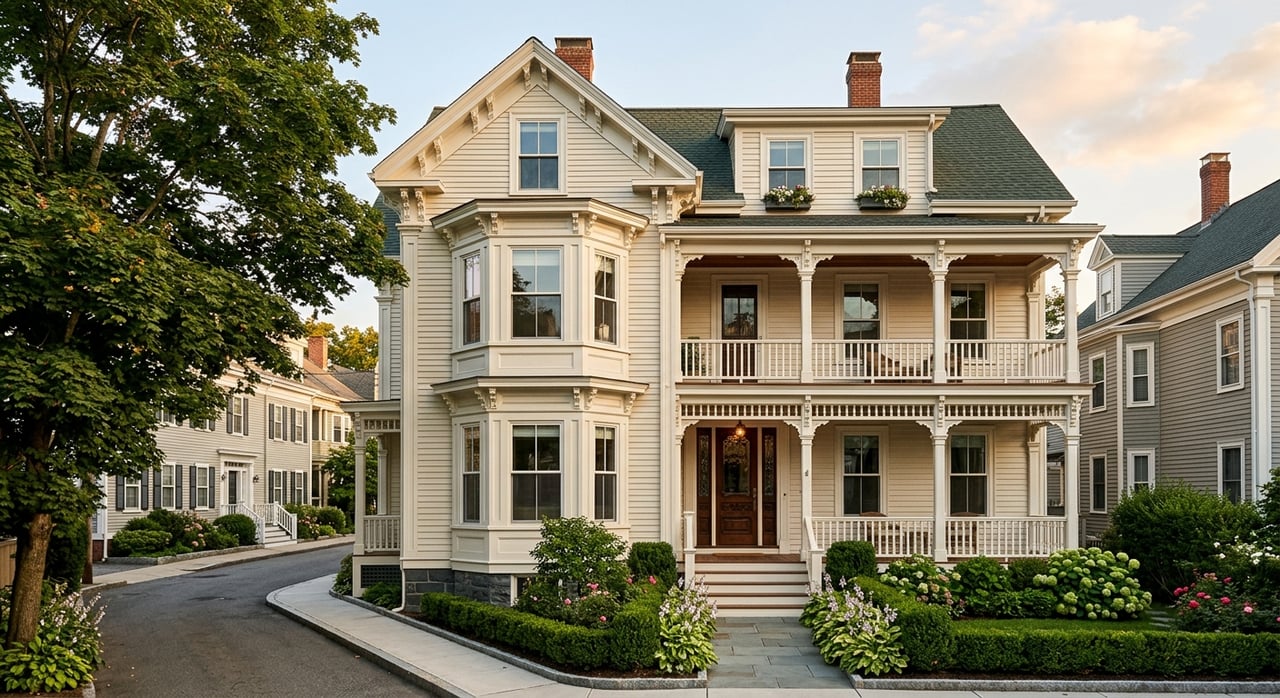
Arlington’s housing stock is older and more built out. The town’s Fair Housing Action Plan states that about 49% of Arlington housing was built in or before 1939, and the town has seen relatively limited recent construction.
That same plan shows about 45% of units are in single-family structures and about 26% are in two-family structures. If you are drawn to established streetscapes, classic Greater Boston homes, and a compact town feel, Arlington may line up well with what you want.
Medford housing character
Medford has a different housing story. Data USA’s Medford profile shows a lower median owner-occupied home value than Arlington, at $755,500 compared with Arlington’s $933,800, though that should not be confused with current sale-price medians.
More importantly, Medford is actively planning for more housing variety. The city’s Housing Production Plan focuses on creating a mix of housing types, and the city reports it created 300 new housing units from 2020 to 2024 while also receiving a 2025 Housing Choice designation.
Why the price comparison can be misleading
This is where buyers can get tripped up. Arlington and Medford have similar recent sale-price medians, but the broader housing stock and owner-occupied value data still point to different inventory profiles.
That means you may get better clarity by comparing house type, condition, location, and commute setup instead of asking which town is simply cheaper. In many searches, that ends up being the more accurate framework.
Shops, restaurants, and town feel
A home search is also a lifestyle search. Arlington and Medford organize their commercial areas in different ways, and that changes how each place feels day to day.
Arlington’s corridor-based feel
Arlington’s business districts are strongly tied to Massachusetts Avenue. The town’s economic development page describes three key districts: Arlington Center, East Arlington, and Arlington Heights.
Arlington Center is the central business district, with restaurants, retailers, museums, and the Regent Theatre. East Arlington is positioned as an arts-and-culture hub, and the town’s Cultural District page emphasizes a walkable stretch from Capitol Square to Arlington Center with direct Minuteman Bikeway access.
Medford’s square-by-square structure
Medford has a more node-based layout. The city’s business development page identifies Medford Square, West Medford Square, Hillside, South Medford Square, and Haines Square as distinct business areas.
That can appeal to buyers who like a city with multiple hubs rather than one main corridor. It also means your experience may vary more depending on which part of Medford you are considering.
Medford’s redevelopment momentum
One of Medford’s biggest differentiators right now is visible change. The city says Medford Square redevelopment planning could bring a grocery store, café, 283 apartments, income-restricted units, a plaza, and parking to the district.
Medford has also supported outdoor dining and temporary retail activity, which adds to the sense of momentum in some commercial areas. If you like the idea of buying into a place that is actively evolving, Medford may stand out.
Which market is easier to navigate?
From a buyer’s perspective, Arlington looks more intense right now. Homes are selling faster and drawing more offers, which can make the search feel more competitive.
Medford is still competitive, but current numbers suggest you may have a little more time to evaluate options. That does not mean Medford is easy or slow. It simply means Arlington appears tighter based on the current data.
A simple buyer-fit framework
If you are deciding where to buy, this quick framework can help you focus on the factors that matter most.
Arlington may fit you better if you want:
- A more compact and established town feel
- Older housing stock with classic Greater Boston character
- Strong identity along the Mass Ave corridor
- Easy access to the Minuteman Bikeway
- Bus connections to Alewife and Cambridge
- A location where walkability and daily convenience are high priorities
Medford may fit you better if you want:
- More rail options for commuting
- A broader mix of transit modes
- A city with multiple business districts and squares
- More visible redevelopment and housing-policy momentum
- A search where current market speed may give you slightly more decision time
- A mix that may include more varied housing formats depending on the area
How to make the final decision
When buyers are torn between Arlington and Medford, I usually recommend narrowing the comparison to three things: your commute, your preferred home style, and your comfort level with market pace. Those factors tend to shape the day-to-day experience more than broad town reputation or headline pricing.
If you want a highly established, compact setting with older housing stock and a strong Mass Ave identity, Arlington often rises to the top. If you want more rail access, more visible change, and a city with several active squares, Medford may be the better match.
The good news is that both towns offer strong access to Greater Boston and both can make sense for buyers at similar price points. If you want a clear, tailored strategy for comparing neighborhoods, home types, and timing, Kelly Batti can help you sort through the tradeoffs with a calm, informed approach.
FAQs
Is Arlington or Medford more competitive for buyers right now?
- Arlington appears more competitive based on current Redfin data, with fewer days on market and more offers per listing than Medford.
Is Medford easier to live in without a car than Arlington?
- Medford generally offers more transit flexibility because it has Green Line, Orange Line, commuter rail, and bus service, while Arlington relies more on buses, biking, and Alewife access nearby.
Does Arlington have older homes than Medford?
- Arlington has a notably older housing stock, with about 49% of housing built in or before 1939 according to the town’s Fair Housing Action Plan.
Are Arlington and Medford priced similarly for homebuyers?
- Recent median sale prices are very close, but the housing stock differs, so buyers should compare condition, home type, commute access, and location rather than relying only on town-wide price averages.
Which town has more redevelopment activity, Arlington or Medford?
- Medford shows more visible near-term change, with housing policy initiatives, zoning work, and redevelopment planning centered around areas such as Medford Square.
What is the biggest lifestyle difference between Arlington and Medford for buyers?
- Arlington tends to feel more corridor-based and established around Massachusetts Avenue, while Medford feels more square-based, transit-diverse, and actively changing in several districts.